
SEO
Why your website is slow on Bangladeshi mobile networks, and how to fix it
Most visitors arrive on a mid-range Android phone on mobile data. What makes sites slow for them, and the fixes that matter most for Core Web Vitals.
Di Injamam Ahmed4 min di lettura
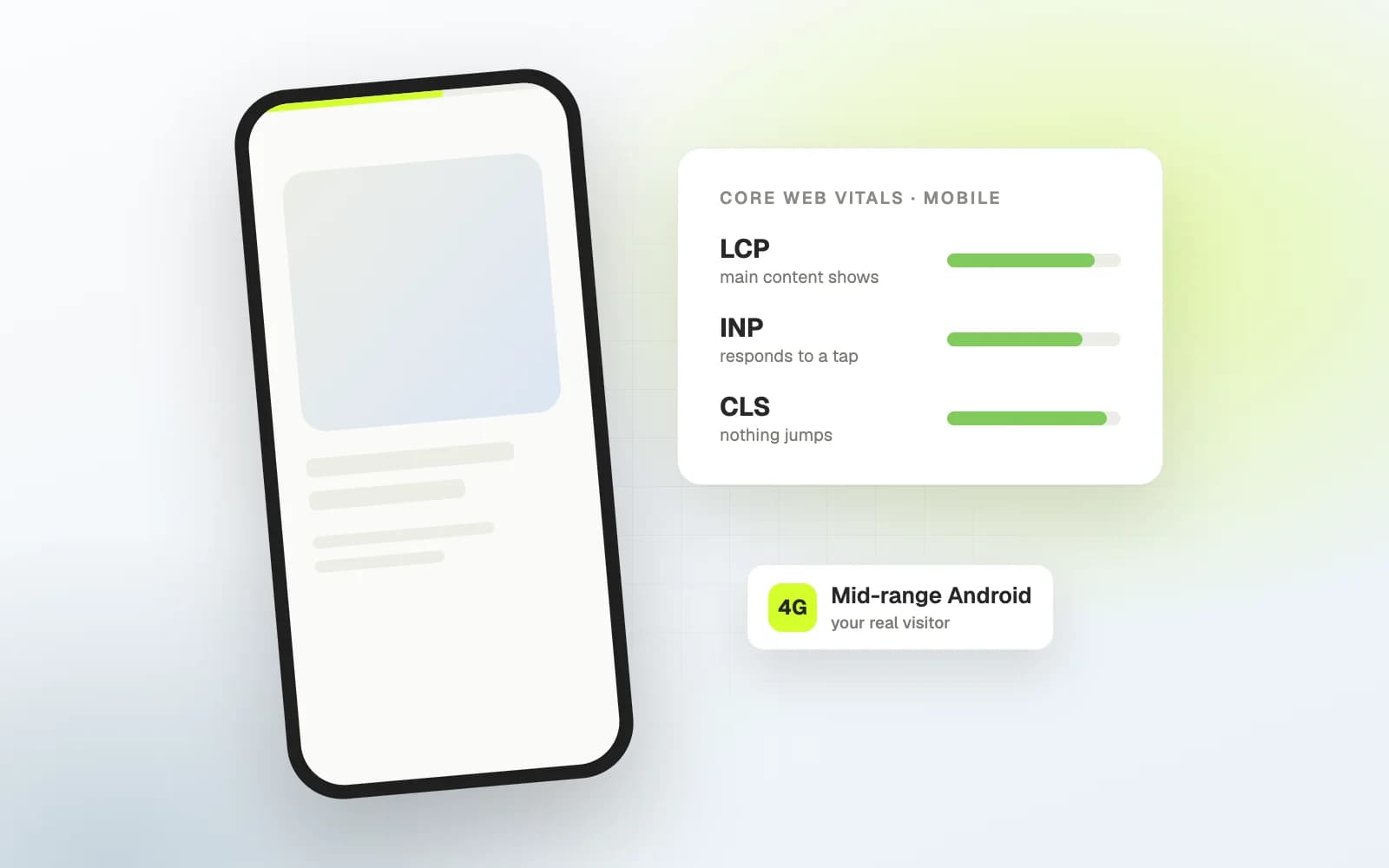
Open your website on a mid-range Android phone, on mobile data, somewhere outside Gulshan. Count how long it takes before you can read anything. For most of your visitors, that is the real website, not the one on your office Wi-Fi.
Speed is not a technical vanity metric. A slow site loses visitors before they read a word, and Google uses page experience, including Core Web Vitals, as one of the signals for ranking. This guide covers why sites are slow on Bangladeshi mobile networks and the fixes that matter most.
Why sites are slow for your real visitors
Three things are true for most visitors in Bangladesh:
- The phone is mid-range. Less processing power means heavy JavaScript takes seconds, not milliseconds, to run.
- The connection varies. 4G in one street, a weak signal in the next. Every extra request is a gamble.
- Data costs money. A page that downloads several megabytes of images is a page some people will not wait for.
A site designed and tested only on a fast laptop hides all three problems.
The three Core Web Vitals in plain language
Google measures three things from real visits:
- Largest Contentful Paint (LCP): how long until the main thing on the page, usually the hero image or headline, appears.
- Interaction to Next Paint (INP): how quickly the page responds when someone taps.
- Cumulative Layout Shift (CLS): how much the page jumps around while it loads, the reason people tap the wrong button.
You can see your scores in Google Search Console, under Core Web Vitals, and test any page with PageSpeed Insights. Look at the mobile results first.
The fixes that matter most
1. Images, by far the biggest win
- Serve modern formats like WebP or AVIF instead of large JPEGs and PNGs.
- Serve each phone an image sized for its screen, not a desktop photo scaled down.
- Load images below the fold only when the visitor scrolls near them.
- Give every image its width and height, so the page does not jump when it arrives.
On a typical slow business site, images are the heaviest thing on the page, so this is where to start.
2. Less JavaScript
Sliders, chat widgets, popups, animation libraries and tracking scripts all compete for the same phone. Remove what does not earn its place. Load the rest after the main content. Every third-party script is someone else's code running on your customer's phone.
3. Fonts that do not block the page
Host your fonts yourself, load only the weights you use, and let text show in a fallback font while the custom font loads. Bangla fonts are large; subset them where you can.
4. Pages built in advance
A page that is built once and served as a ready file is faster than one assembled from a database on every visit. For pages that do not change minute to minute, such as services, case studies and blog posts, static generation is the simplest speed win there is. It is how we rebuilt our own site after we left WordPress.
5. Hosting close to your visitors
If your visitors are in Bangladesh and your server is on another continent, every request travels further. A content delivery network, or a server in the region, shortens the trip.
6. Fewer redirects and requests
Each redirect and each separate file is another round trip on a slow connection. Combine what you can and remove what you do not need.
A ten-minute test you can run today
- Open PageSpeed Insights and test your home page and your most important product or service page, on mobile.
- Note the LCP, INP and CLS scores.
- Open the same pages on a mid-range Android phone on mobile data and time how long until you can read and tap.
- Look at the largest images on the page and check their file size.
- Count the third-party scripts: chat, popups, trackers, embedded videos.
If the phone test feels slow, it is slow for your customers too.
What speed is worth
Speed does not replace good content or a clear offer, but it decides whether visitors stay long enough to see them. For an online store, every second on the product page is a second the buyer can change their mind. For a service business, a slow page is the first impression of how you work.
Questions we get asked
Does a faster site rank higher on Google?
Page experience is one of many signals. A fast site will not outrank a better answer, but between two similar pages, the faster one has an advantage, and visitors are more likely to stay.
My site scores well on desktop. Is that enough?
No. Google primarily looks at the mobile version of your site, and most of your visitors are on phones. Always check mobile first.
Can my existing site be made faster, or does it need a rebuild?
Many sites can be improved a lot with images, scripts and caching. A rebuild makes sense when the platform itself is the bottleneck, for example a heavy theme with many plugins.
If your site feels slow on a phone, send us the link. We will tell you the three changes that would make the biggest difference. See how we build fast sites on our web development services page.