Guida
Digital marketing you can measure: set up tracking before you spend on ads
Why Facebook ads in Bangladesh often run blind, and what to set up first: Meta Pixel, Conversions API, GA4, UTM tags, and honest tracking for COD.
Di Injamam Ahmed4 min di lettura
It is a familiar story for many businesses looking for a digital marketing agency in Dhaka: the Facebook ads are running, money is being spent every day, orders come in, and nobody can say which taka brought which order. The ads might be working. They might be burning money. There is no way to tell.
The fix is not a better ad. It is tracking, set up properly before the next campaign. This guide covers what to set up, in what order, and who should own it.
Why ads in Bangladesh so often run blind
Three things make measurement harder here than the textbooks assume:
- Cash on delivery. An order placed is not an order paid. If you optimise for "purchase" at checkout, you also optimise for fake and cancelled orders.
- Orders that move to chat. Many buyers see an ad, then order on Messenger or WhatsApp. The website never sees the sale.
- Browsers and phones that block tracking. A growing share of visits are invisible to browser-only tracking.
None of these are reasons to give up on measurement. They are reasons to set it up carefully.
The tracking to set up first
1. One owner for every account
Before anything else: the Meta Business Manager, the ad account, the Pixel, Google Analytics and Google Tag Manager should belong to your business, with the agency added as a partner. If the agency owns them, your history leaves when they do.
When we started on MJ Mart, we set the tracking up inside the client's own Business Manager for exactly this reason: the data belongs to the business that paid for it.
2. Meta Pixel with the right events
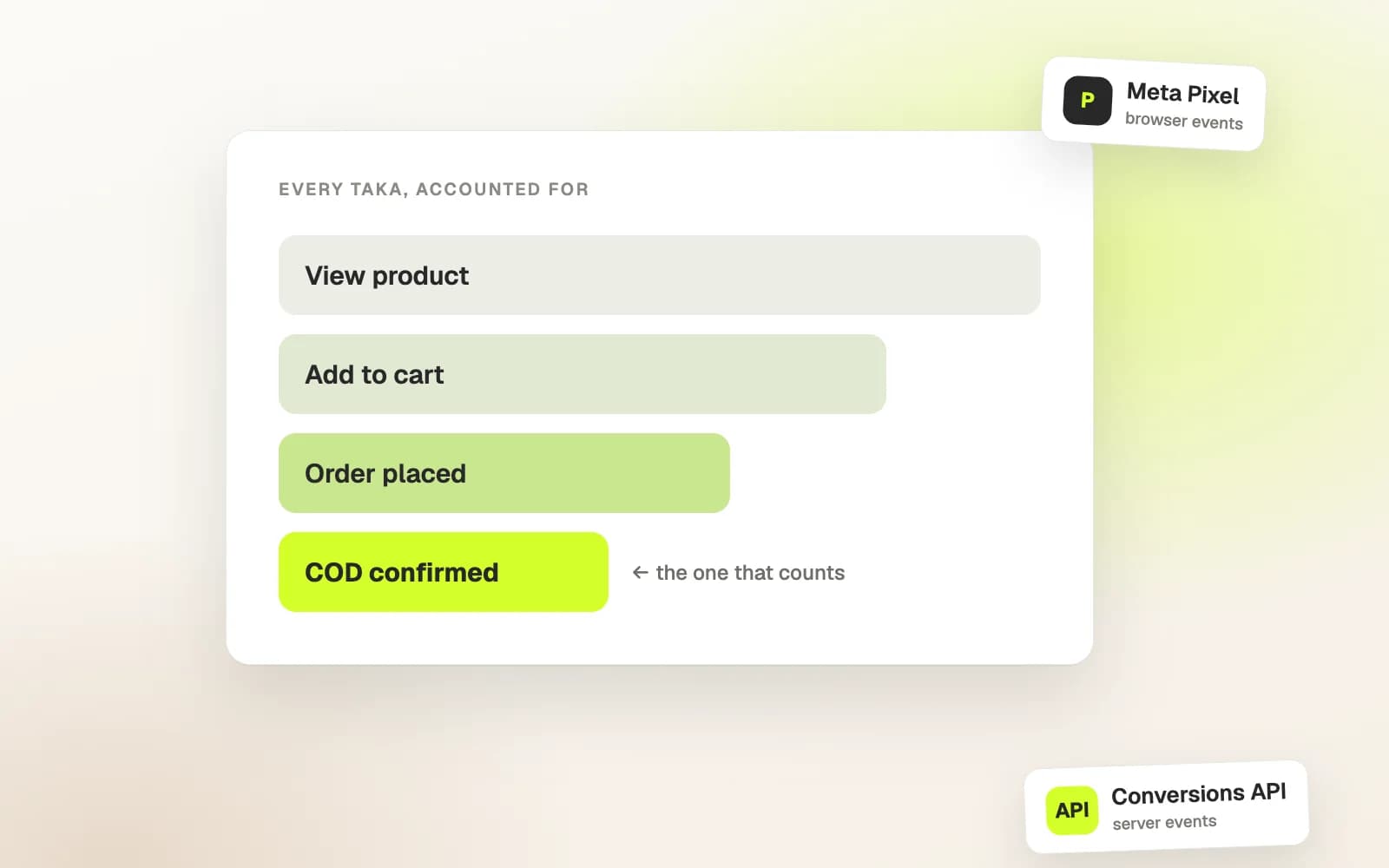
Install the Pixel and send the events that describe your funnel: viewing a product, adding to cart, starting checkout and purchase. Use the real product, price and currency in each event, so Meta learns what kind of order you want more of.
3. Conversions API alongside the Pixel
The Conversions API sends the same events from your server, not just from the browser. It catches the visits the browser misses. Send both, with a shared event ID, so Meta counts each event once.
4. Google Analytics 4 with the same events
GA4 gives you the picture across channels: Facebook, Google search, direct visits and links from WhatsApp. Name the events consistently with the Pixel, so the two tell the same story.
5. UTM tags on every link you control
Tag the links in your ads, your Facebook posts, your WhatsApp broadcasts and your email. It takes seconds and it is the only way to tell later which post sent the visitor.
Handling cash on delivery honestly
For a COD business, the order that matters is the one that was delivered and paid. Three practical steps:
- Confirm before you count. Many shops call to confirm COD orders. Record that confirmation in your system.
- Send the confirmed sale back. Once an order is confirmed or delivered, send it to Meta as an offline or server event. Your campaigns then learn from real buyers, not from people who abandon at the door.
- Track cancellations. A campaign that brings many orders and many cancellations is worse than one that brings fewer orders that arrive.
We wrote about designing checkout around this in cash on delivery is not a fallback.
Capturing orders that move to chat
If customers order on Messenger or WhatsApp, give each campaign its own route in: a separate link, a message template or a code. Then log chat orders in the same place as website orders. A simple order form your staff fill in for chat orders is far better than a WhatsApp group nobody can search.
What to look at every week
Once tracking is in place, a weekly review needs only a few numbers:
- Spend by campaign.
- Confirmed orders by campaign, not just placed orders.
- Cost per confirmed order.
- Cancellation rate by campaign.
- Which posts and audiences bring buyers who return.
If those five numbers are trustworthy, every decision about budget becomes easier.
The website matters as much as the ad
Tracking only measures what happens. If the product page is slow on mobile data, or the checkout asks for too much, the best campaign still loses. Fix the page before you raise the budget; our post on making your site fast on mobile networks covers the basics.
Questions we get asked
Do I need the Conversions API if I already have the Pixel?
Yes, if ads are a meaningful part of your sales. The Pixel alone misses a share of events that browsers block. The server-side events fill the gap.
Can I set this up myself?
Much of it, yes, with patience. The parts that touch your website and server, such as server events and sending confirmed orders back, usually need a developer.
How soon will I see results?
Tracking does not raise sales on its own. It shows you, within a few weeks, which campaigns to stop and which to grow. That is where the money is saved.
If your ads are running and you cannot say what they bring, book a call. We will look at your setup with you. Read more about how we work as a digital marketing agency in Dhaka.