
Caso studio
Selling a battery nobody can inspect
TE POWER makes batteries at its own plant and sells through dealers in 64 districts. None of it was visible online. Building a site for a trust purchase.
Di Injamam Ahmed5 min di lettura
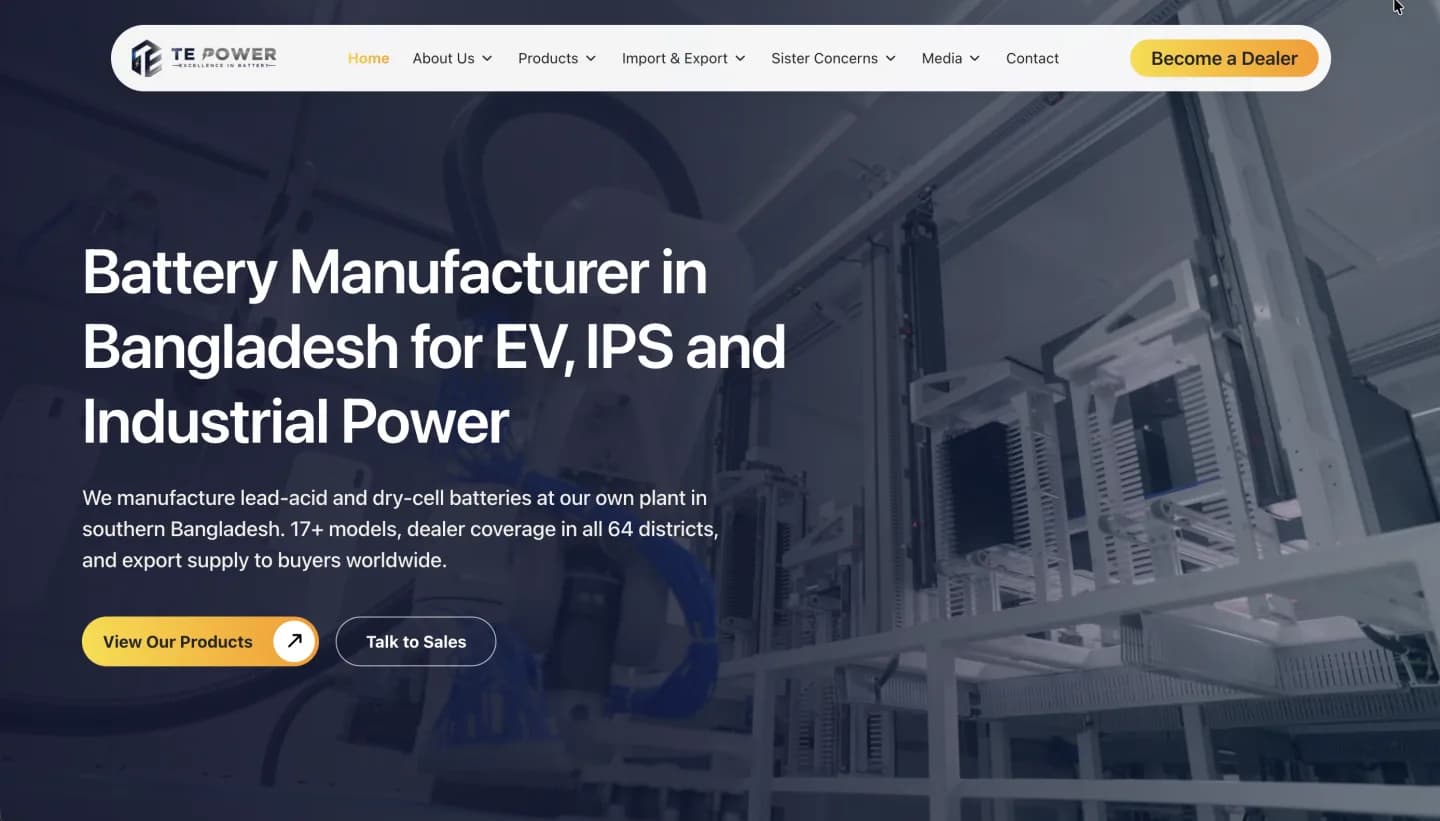
T.E Industrial has been manufacturing batteries in southern Bangladesh since 2019. They sell through dealers in all 64 districts, under the TE POWER brand, and they own the plant the batteries come out of.
None of that was visible online. A dealer weighing up whether to stock the brand, a fleet operator replacing a hundred batteries, an export buyer in another country — each of them had to decide on a phone call and a price list.
That is a hard way to sell a battery, because a battery is a trust purchase. It sits in a vehicle or a backup system for years. Nobody can tell a good one from a bad one by looking at it, and by the time they can, the sale is long over and the reputation is already made.
This post is about building the site for a product like that.
The catalogue is not the hard part
There are four product families and more than seventeen models. Putting them on a website is a solved problem, and if that had been the brief we would have shipped it in a week.
The hard part is that a catalogue answers "which one" and buyers arrive asking "why you".
So the catalogue had to do two jobs at once: let someone who already knows the model find it fast, and let someone who does not yet trust the manufacturer arrive at the range through a route that makes sense to them.
Organised by application, not by SKU
Most manufacturer sites list products the way the factory thinks about them — by chemistry, by capacity, by internal code. That is the wrong first question for almost everyone visiting.
A buyer does not think "I need a 12V lead-acid unit". They think "I run electric three-wheelers", or "I need IPS backup for the office", or "I sell dry cells in my shop". Those are three different people with three different budgets, and they should not land on the same page.
So the range splits by application first. Electric-vehicle batteries, IPS and backup, and dry cells each get their own route in, with the models underneath. Someone who knows exactly which model they want can still go straight to it. Someone who does not gets a path that starts with a sentence they recognise as their own situation.
This sounds like an information-architecture nicety. It is actually the difference between a site that sells and a spreadsheet with pictures.
The plant is the argument
The company's real advantage is that it makes the batteries itself. Vertical control of manufacturing is exactly what a dealer or an export buyer is trying to assess, and it is the thing most competitors cannot honestly claim.
That argument cannot live in one line on an About page.
So manufacturing gets its own space on the site — how a battery is made, and specifically how it is checked. Raw material inspection when it arrives. In-process monitoring while the battery is being built. Final testing before it leaves. And batch traceability, so a unit can be tracked back to the run it came from.
Three checkpoints and a traceable batch number is a claim someone can interrogate. "High quality" is not. The whole point of putting the process on the site is that it converts an assertion into something a buyer can ask a specific question about — and a buyer who asks a specific question is a buyer who is still in the conversation.
Sixty-four districts is a fact, so show it as one
The dealer network covers every district in the country. That is genuinely unusual and it is the answer to the question a fleet operator always asks next: if one of these fails in eighteen months, who fixes it, and how far away are they?
Coverage answers a service question, not a sales one, and it is worth a page rather than a bullet point. A buyer who can see that support exists near them is a buyer who does not need to be reassured about it on the phone.
What we deliberately left out
No pop-ups. No "request a quote" modal firing on scroll. No live-chat widget from a third party loading a script on every page of an industrial manufacturer's website.
Buyers in this category do not convert to urgency tactics — they convert to being able to check things. Every element on the site is either information they came for or a way to start a conversation when they are ready. Enquiries route to sales, and the export and industrial-service sections have their own entry points, because an export buyer and a local dealer are not the same lead and should not land in the same inbox.
There is also a news section, which matters more for a manufacturer than for most businesses. A plant that posts about a new model or a certification is visibly a going concern. A site that has not changed in two years quietly says the opposite, whatever it claims on the homepage.
What we would tell another manufacturer
If you make something physical and sell it through a network, your website is not a catalogue. It is the place a buyer decides whether you are a real company before they will take your call.
Three things do most of the work.
Organise the range by the buyer's situation rather than your internal taxonomy — they should recognise themselves in the first click. Put the process on the site in enough detail to be checked, because a checkable claim is worth ten adjectives. And make the service network visible, because "what happens when it fails" is the question your buyer is actually asking and rarely says out loud.
None of that requires clever technology. The TE Power site is a fast static build with a proper catalogue structure and search-engine work aimed at how dealers and buyers actually search. The engineering was straightforward. The thinking about what a battery buyer needs to see before they trust you was the job.
We build sites for manufacturers and distributors who sell through dealer networks. If that is your business and your range currently lives in a PDF, we are happy to look at it with you.