
دراسة حالة
Taking an estate agency off the portals
Fifteen Avenue sells on personal knowledge of a small portfolio; a portal throws that away. What we built instead, in two languages and two cookies.
بقلم Injamam Ahmed5 دقائق قراءة
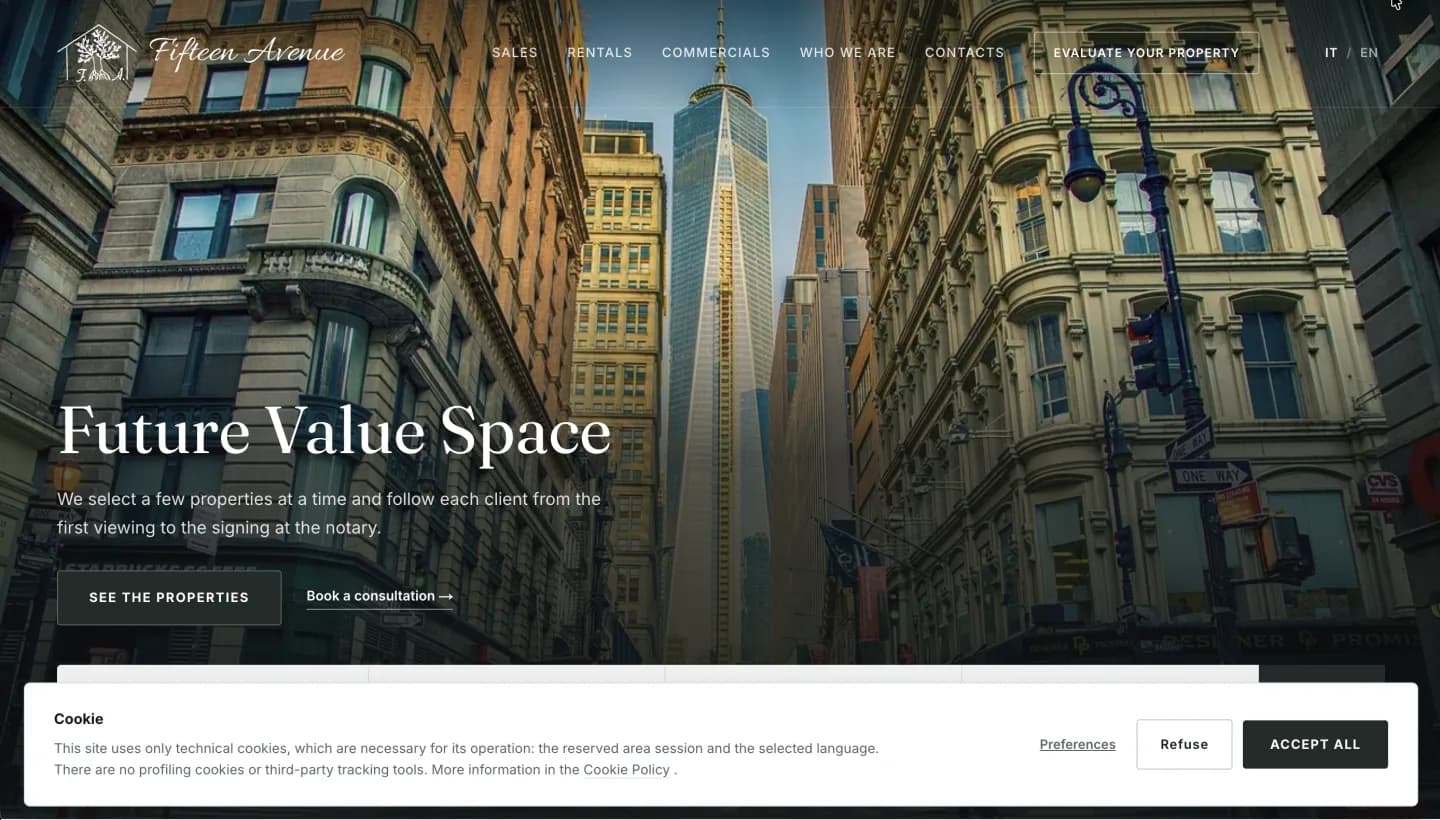
Fifteen Avenue is an estate agency in Vespolate, a small town in the province of Novara. It works on a handful of properties at a time, and the person running it knows every one of them personally.
That is the whole business, and a portal listing throws it away. On a portal, a curated selection looks the same as a scraped one. The agency sits on a page beside every competitor, sorted by whoever paid more that month, described in the same four fields as everything else.
So we built the agency its own platform. This post is about what that had to include to be worth doing, and the parts that mattered more than they look.
Two languages, not one with a translation
Novara is an hour from Milan and about the same from the Swiss border. Buyers are local, and buyers are also people relocating from abroad who read English and no Italian at all.
A translated site is not the same thing as a bilingual one. A translated site has a real version and a copy: the Italian pages get updated, the English pages drift, and a listing that sold in March is still for sale in the English half in June. We built both languages as first-class routes over the same data, so a property has one record and two presentations. The status badge on a listing is not written twice.
The language choice is remembered in a cookie, which turns out to be one of only two cookies the site sets. More on that below.
The listing card is the product
Most of the work went into what a property looks like before you click it.
Each one carries a reference code, floor area in square metres, number of rooms, number of bathrooms, and its energy class. Those are the fields an Italian buyer actually compares, and the energy class in particular is not decoration — it is a legal disclosure that changes what a flat costs to live in.
Then there is status. A listing is exclusive, or new, or reduced, or under offer, or sold. Portals tend to hide this: a sold property quietly disappears, which is convenient for the portal and useless for a visitor trying to judge whether an agency is any good. We show it. A page of listings where several say sold is evidence the agency sells things.
Search narrows by sale, rental or commercial, then by category, city and maximum price. Four filters, not fourteen. The agency does not have enough properties at once to need more, and a filter panel that returns zero results on every combination makes a small portfolio look empty rather than curated.
The back-office is the reason it stays true
A listing platform is only worth having if it reflects reality, and reality changes on a Tuesday afternoon when a buyer's offer is accepted.
The agency manages properties from a private area on the same site — reference, size, rooms, energy class, photographs, status. No export from a portal, no spreadsheet, no email to a developer. The site shows the state of the portfolio because the portfolio is where the site gets its data.
This is the part clients underestimate when they compare quotes. A site you cannot update yourself is a site that becomes wrong, and a wrong site is worse than no site: it tells a visitor the agency does not pay attention.
Two cookies, and a consent banner that means something
The site sets a cookie for the private area's session and a cookie for the chosen language. That is all. There is no analytics script, no advertising pixel, no embedded map phoning home, no font loaded from someone else's server.
This was a decision, not an accident. GDPR applies here properly — the agency is in Italy, its buyers are in the EU — and the honest way to handle it is to not collect anything that needs a justification. The consent notice says exactly that, and it is short enough to read.
It also happens to make the site fast, because the fastest third-party script is the one you did not add.
The valuation request is the real conversion
An estate agency does not make money from people browsing listings. It makes money from people who own a property and are deciding whether to sell it.
So the free valuation is not buried in a contact page. It is a route of its own, offered wherever a seller is likely to be reading, and the promise attached to it is specific: a written estimate based on real transactions in the area rather than a portal average. That sentence is the agency's actual opinion about its own market, and it is the reason someone calls.
Alongside it, WhatsApp. In Italy as in Bangladesh, a message is a lower step than a form, and an agency that answers WhatsApp closes more first conversations than one that does not.
What we would tell another agency
Three things, in order of how much they matter.
Own the platform. A portal rents you visibility and keeps the relationship. Your own site is the only place your curation is visible as curation.
Show the sold ones. Evidence beats adjectives. A visitor deciding whether to trust you is looking for proof you have done this before, and a sold badge is proof in a way that "professional service since 2003" is not.
Keep it editable. The most expensive site is the one that quietly goes out of date, because nobody notices the cost until a buyer asks about a property that sold six weeks ago.